
Family Law Cases in San Francisco
San Francisco Superior Court operates a Unified Family Court that handles all family law matters in the city and county. Cases include dissolution of marriage, legal separation, child custody and visitation, child support, spousal support, domestic violence restraining orders, and parentage actions. The court sits at the Civic Center Courthouse at 400 McAllister Street. San Francisco's unique city-county structure means the Superior Court serves both functions. Family law services are centralized at one main location with specialized judges who hear only family law cases. The ACCESS Center provides free self-help services including forms, computers, and staff assistance for people representing themselves. While basic case information may be searched online through the court system, complete family law case files must be viewed in person due to California privacy restrictions on family court records.
San Francisco County Family Court
Unified Family Court System
San Francisco operates a Unified Family Court system at the Civic Center Courthouse. The courthouse is located at 400 McAllister Street in downtown San Francisco. Family law cases are heard on the fourth floor in Department 402 and other family law courtrooms. The Unified Family Court model means judges specialize in family law and handle cases from start to finish.
The clerk's office for family law is in Room 402. Hours are Monday through Friday, 8:30 AM to 4:00 PM. The office may close for lunch or on court holidays. Call (415) 551-3900 before visiting to confirm hours. Bring photo ID. Security screening is required to enter the courthouse. Lines can be long during morning hours, so arrive early.
The court website at sf.courts.ca.gov/divisions/unified-family-court/family-law provides forms, filing information, and self-help resources. The site includes guides for divorce, custody, child support, and restraining orders. Forms can be downloaded or picked up at the clerk's office or ACCESS Center.
Accessing Case Information
San Francisco does not offer full public remote access to family law case files. California Rules of Court restrict online viewing of family law documents. The court may provide basic case information over the phone if you have the case number. For detailed case information, visit the courthouse.
At the courthouse, you can view registers of action showing what documents were filed and hearing dates. To see actual petitions, responses, declarations, or orders, you must review the case file in person. The clerk's office has public terminals for searching and viewing case information. Staff can show you how to use the system.
Copies cost 50 cents per page. Certified copies add $40 for certification. You need certified copies for official purposes like filing with other agencies. Regular copies work for your personal records. The clerk's office accepts cash, check, and credit or debit cards for copy fees.
Filing Family Law Cases
Filing a family law case starts with completing California Judicial Council forms. For a divorce, you need form FL-100 (Petition), a summons, and other forms depending on your situation. The ACCESS Center can provide a list of required forms. Forms are available on the court website or at the ACCESS Center.
Bring completed forms to the clerk's office in Room 402 on the fourth floor. The filing fee is $435 for the first paper. If you cannot afford the fee, file form FW-001 to request a fee waiver. Bring proof of income and expenses. The court reviews fee waiver applications based on financial need.
After filing, you must serve the other party with copies of all documents. Service must be done by someone over 18 who is not a party to the case. You cannot serve papers yourself. Use a process server or the sheriff. File proof of service with the court after service is complete. Your case cannot proceed until service is done and proof is on file.
Additional filings during your case cost $60 per motion. Some documents have no fee. The clerk can tell you if a fee applies to your filing.
ACCESS Center Self-Help Services
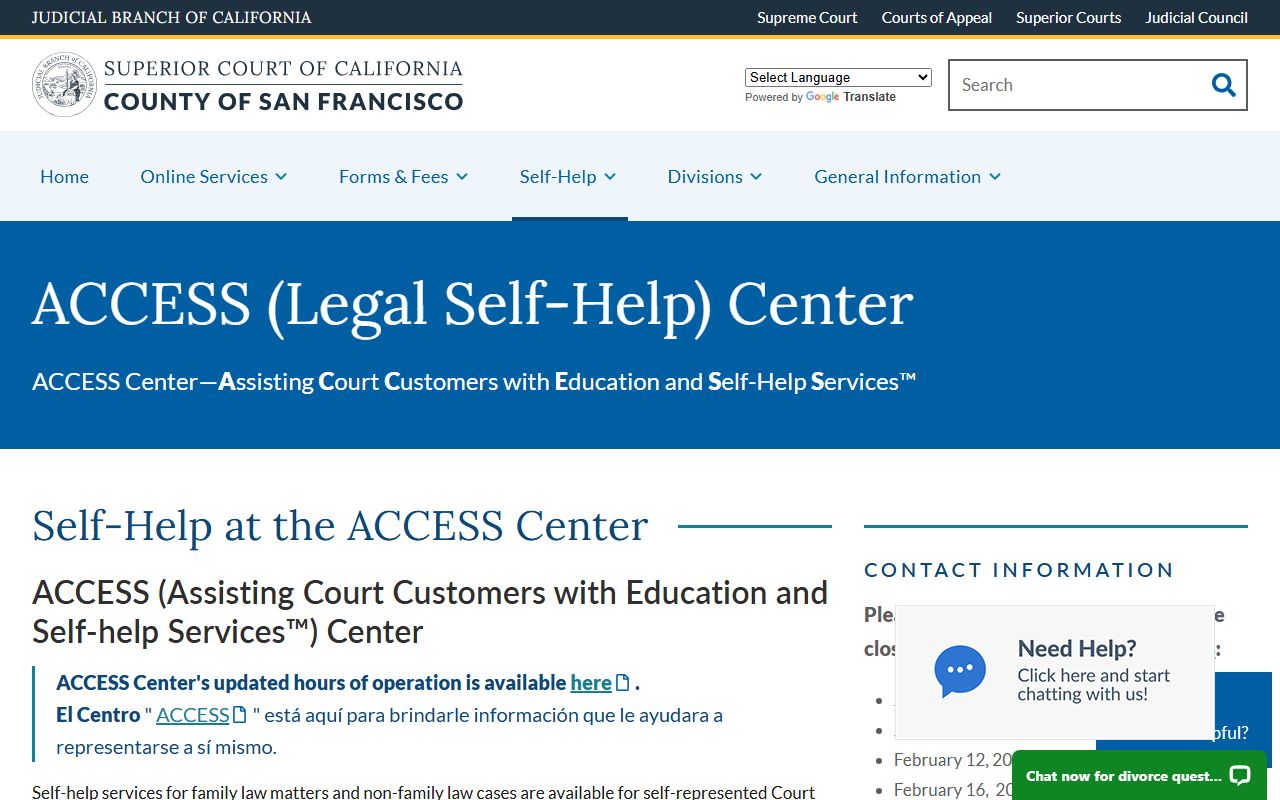
The San Francisco Superior Court ACCESS Center provides free help with family law matters. The center is located at the Civic Center Courthouse. Call (415) 551-0605 for hours and services. Staff can answer questions about court procedures and forms. They cannot give legal advice about your specific case.
The ACCESS Center offers computers, printers, and form packets for common family law issues. Staff can help you figure out which forms to use and how to complete them. Services are available in English and other languages through interpreters. The center also offers workshops on divorce, custody, child support, and restraining orders.
Bay Area Legal Aid provides free legal services to eligible low-income residents. Call 1-800-551-5554 for intake. Income limits apply. The organization prioritizes cases involving domestic violence and urgent custody matters. Wait times for full representation can be several weeks or months due to high demand.
The San Francisco Bar Association operates several legal aid programs. The Volunteer Legal Services Program connects people with pro bono attorneys. Call (415) 782-8982 for information. The Lawyer Referral Service at (415) 989-1616 can connect you with a private attorney for a reduced-cost consultation.
Note: San Francisco has strong tenant protections and housing legal aid, but family law services focus on custody, support, and divorce matters.
Court Fees and Costs
The first filing in a family law case costs $435. Motions cost $60 per filing. Some documents have no fee. Ask the clerk if unsure about fees for a specific filing.
Copy costs are 50 cents per page. Certified copies add $40. Process servers in San Francisco typically charge $100 to $150 per service due to the urban setting and parking challenges. The sheriff offers service at lower rates. Budget for service costs when planning to file.
Fee waivers cover court filing fees but not service fees. If your fee waiver is granted, you may qualify for free sheriff service. Ask about this when filing your waiver application.
Nearby Counties
San Francisco is a city-county. If you live in a neighboring county, you must file there. Family law cases are filed where you or your spouse reside.