
Search Santa Barbara County Family Court Records
Family court cases in Santa Barbara County go through the Superior Court. The court handles dissolution proceedings, custody disputes, child support matters, and domestic violence cases. You can search for case details online using the court's portal system. All cases filed in Santa Barbara County become part of the public record unless sealed by a judge. The courthouse in Santa Barbara serves as the main location but the county has other courthouses for residents in different areas. Self-help services are available for people filing without an attorney. These services include form help and general process information.
Santa Barbara County Family Court
Santa Barbara Superior Court
The main courthouse sits at 1100 Anacapa Street in Santa Barbara. This location handles most family law filings for the county. Court staff work at the clerk's office on the first floor. Hours run from 8:00 AM to 4:00 PM on weekdays. The building closes for lunch from noon to 1:00 PM. You need photo ID to enter. Security screening happens at the entrance so plan extra time before your hearing.
Santa Maria has a courthouse at 312 E. Cook Street. This serves the northern part of the county. Lompoc residents can use the courthouse at 115 Civic Center Plaza. Which courthouse you use depends on where you live. The court assigns cases based on your residence address when you file. Check the court website at www.santabarbara.courts.ca.gov/divisions/family-law for details on which location serves your area.
Family law judges hear cases at all three locations. Some judges rotate between courthouses. Case calendars show which judge will hear your matter. You can view calendars online or at the courthouse. The clerk's office can tell you which department your case is assigned to. Each department has its own procedures and local rules.
Note: Call ahead if you need special assistance or accommodations during court proceedings.
Online Case Search Portal
Santa Barbara County provides an online portal for case searches. Access it at portal.sbcourts.org/CASBPORTAL. You can search by party name or case number. The system shows basic case information like filing date and case type. It displays the register of actions which lists all documents filed and court appearances held.
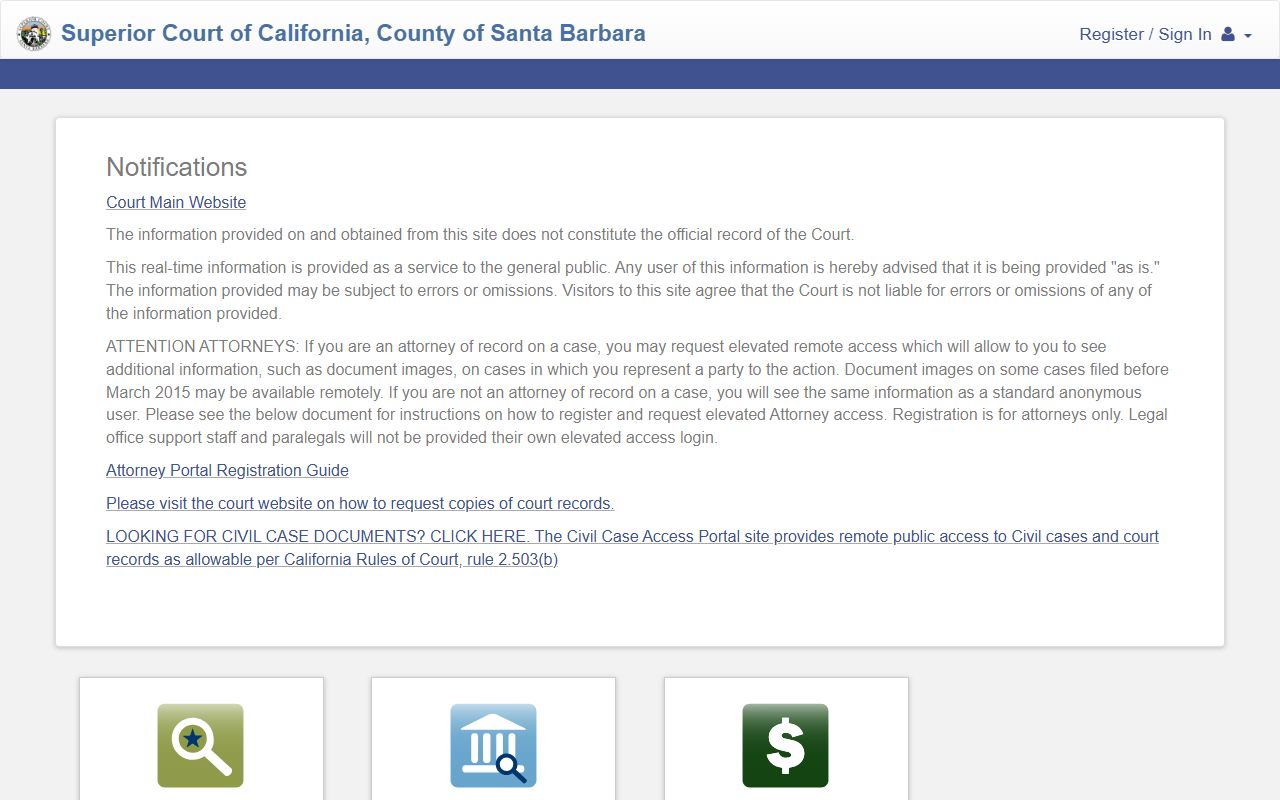
California law limits what family court records appear online. You cannot view full documents remotely for family law cases. The portal shows you what was filed but not the actual content of those filings. To see complete documents you must visit the courthouse. Bring your case number and photo ID when requesting documents.
The portal is free to use. You do not need an account to search. Searches work best with exact names or case numbers. Results show multiple cases if the name is common. Make note of the case number from your paperwork to find the right case quickly.
How to File Family Court Cases
Start by getting the right forms. California Judicial Council forms are used statewide. Form FL-100 begins a dissolution case. Other case types use different forms. You can download forms from the California Courts website or pick them up at the self-help center. Staff can point you to the correct forms for your situation.
Fill out all required forms completely. Missing information delays processing. Take your forms to the clerk's office during business hours. The filing fee is $435 for the first paper. This covers the petition and initial response. If you cannot pay the fee, ask for form FW-001 to request a waiver. The court reviews fee waiver requests and approves them based on income. Bring pay stubs or benefit letters as proof of income.
After filing, you must serve the other party. Service means officially delivering copies of your filed papers to the other person. You cannot serve papers yourself in family law cases. Use a process server, the sheriff, or certified mail depending on the situation. File proof of service with the court after service is complete. Your case cannot move forward until proper service is filed.
Family Law Self-Help Center
The self-help center operates at the Santa Barbara courthouse. Call (805) 882-4660 for information. Staff provide help with forms and court procedures. They cannot give legal advice about your specific case. They can explain how to fill out forms and what steps to take next.
Santa Maria has self-help services at its courthouse. Call (805) 614-6442 for that location. Both centers offer walk-in assistance and scheduled appointments. Services include computer access, printers, and form packets. Most help is available in English and Spanish. Workshop schedules change so call ahead to find out about upcoming sessions on topics like divorce or child custody.
Legal Aid Foundation of Santa Barbara County provides free legal help to qualifying low-income residents. Reach them at lafsbc.org or (805) 963-6754. They handle cases involving domestic violence and urgent custody matters. Income limits apply. Call for a screening to see if you qualify for their services.
Getting Copies of Court Records
Visit the clerk's office to request copies. Staff need your case number to locate files. Copies cost 50 cents per page. Certified copies add a $40 fee on top of the copy charges. You need certified copies for official use like filing with another agency or court. Regular copies work fine for your personal records.
Some documents in family law cases are confidential. The clerk checks whether you have a right to see specific documents. Parties in the case can always view their own case files. Others may need court permission. Income and expense declarations have restricted access. Bring photo ID when requesting any court documents.
Processing time for copies varies. Simple requests might be ready the same day. Large files take longer. You can wait for copies or come back to pick them up. Some courthouses accept copy requests by mail. Include a self-addressed stamped envelope and payment by check or money order if mailing your request.
Cities in Santa Barbara County
Santa Barbara County includes several cities. Residents file family law cases at the Superior Court regardless of which city they live in.
Nearby Counties
Check jurisdiction if you live near the county line.