
Find Santa Cruz County Family Court Records
Family law cases in Santa Cruz County are filed with the Superior Court. Cases include divorce, legal separation, child custody, child support, spousal support, and domestic violence restraining orders. The court operates two main locations in Watsonville and Santa Cruz. You can search case information through the online portal using a party name or case number. Most records are public but some get sealed for privacy. Self-help services help people without lawyers understand forms and procedures. The law library also provides resources and research assistance for family law matters in the county.
Santa Cruz County Family Court
Santa Cruz Superior Court Family Division
The Watsonville courthouse at 1 Second Street handles family law cases. This is the main filing location for family law in Santa Cruz County. The clerk's office operates Monday through Friday from 8:00 AM to 4:00 PM. The office closes from noon to 1:00 PM for lunch. Security screening is mandatory for all courthouse visitors. Bring valid photo ID to enter the building.
Santa Cruz has a courthouse at 701 Ocean Street. Some family law matters are heard at this location. Most new filings go to Watsonville. You can check which courthouse your case is assigned to by looking at your court papers or calling the clerk's office at (831) 786-7200. The court website at www.santacruz.courts.ca.gov/divisions/family-law-division provides details about both locations and their services.
Family law judges in Santa Cruz County hear only family law cases. This specialization means judges understand the complex issues in custody, support, and property division. Your case gets assigned to a department when you file. The assignment shows on the court's calendar and on documents you receive. Different departments have different local rules. Ask the clerk if you have questions about your assigned department's procedures.
Case Portal and Online Access
The county provides online case access through a portal at portal.santacruzcourt.org/portal. You can search for cases by name or case number. The portal is free and requires no account. Search results show basic information like case number, filing date, and parties. The register of actions lists all documents filed and all court hearings held in the case.
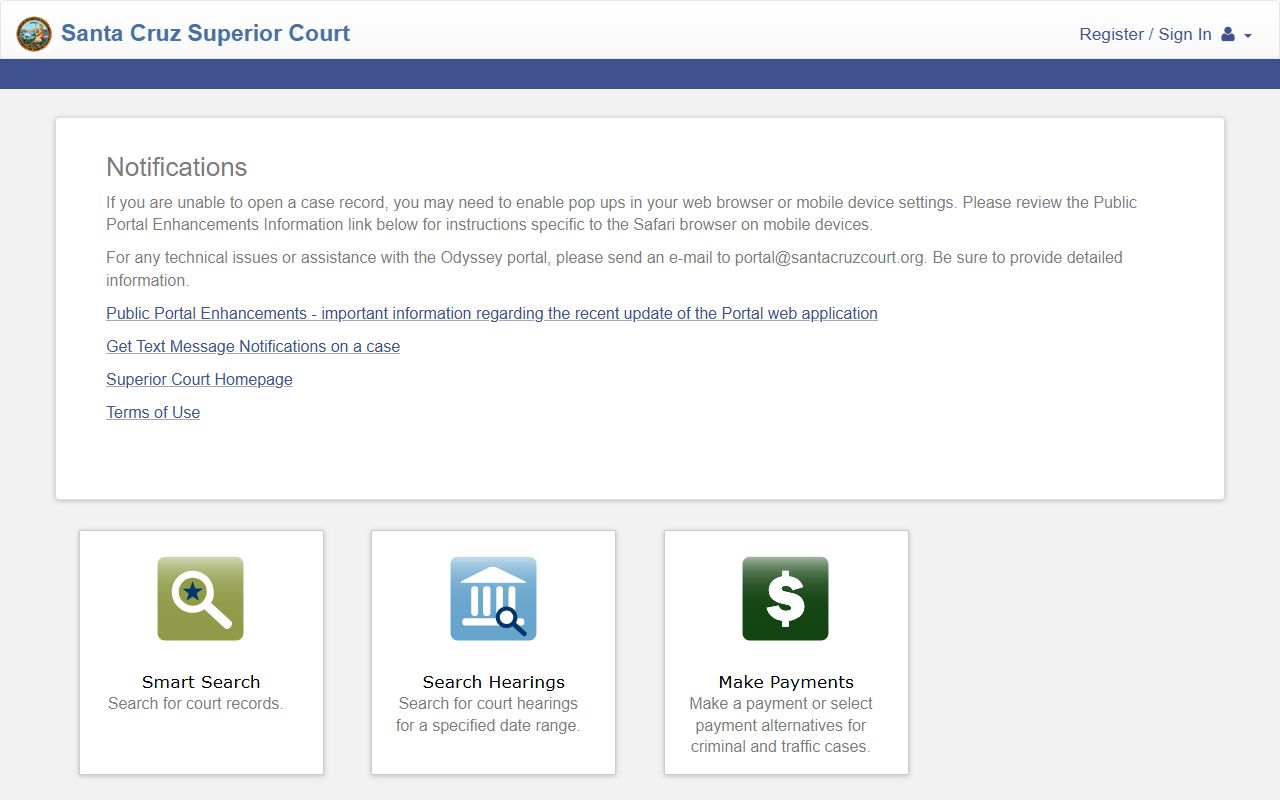
California Rules of Court limit what you can see online for family law cases. Complete documents do not appear in the portal. You can see what was filed but not the contents. This applies to petitions, responses, declarations, and other filings. To view full documents you must go to the courthouse. Bring your case number and ID when asking for documents from the clerk.
The portal updates daily. New filings may not show up immediately. Give the system 24 hours to reflect recent activity. Searches work best with exact name spelling. If you get too many results, add a middle name or use the case number if you have it. The system shows both active and closed cases in search results.
Note: Portal access may be unavailable during system maintenance periods, usually late at night.
Filing Family Law Documents
All filings start with the correct forms. California uses statewide Judicial Council forms. Get forms online from the California Courts website or pick them up at the courthouse. The self-help office has form packets for common case types. Dissolution cases begin with form FL-100. Custody cases without dissolution use form FL-300. The clerk or self-help staff can tell you which forms you need.
Fill out forms completely and accurately. Sign where required. Make copies before filing. Keep one set for yourself. Take the originals to the clerk's office at the Watsonville courthouse. The first filing costs $435. This covers your petition or response. If you cannot afford the fee, ask for a fee waiver. Form FW-001 is the application for a waiver. The court decides waivers based on income and expenses. Bring proof of income like pay stubs or benefit statements.
After you file, you must serve the other party with copies. Service is the legal way to deliver court papers. You cannot serve papers yourself in most family law cases. Hire a registered process server or use the sheriff's office. Certified mail works for some document types. File proof of service with the court once service happens. The case stops if service is not completed properly.
Self-Help Services and Legal Aid
The Family Law Self-Help Office provides free help with forms and procedures. Staff answer questions about how to fill out paperwork and navigate the court process. They cannot give legal advice about what you should do in your case. The office is at the Watsonville courthouse. Call (831) 786-7200 for information and hours. Services include form review, procedure explanations, and general information about family law.
The Santa Cruz County Law Library offers research help and resources. The library has computers, legal books, and online databases. Staff can help you find information about California family law. The library website at www.sclawlib.org/self-help-2/community-resources lists community legal resources and self-help guides. Library services are free to the public.
Legal Services for Seniors provides free help to people age 60 and older in Santa Cruz County. They handle family law issues including divorce and custody when grandparents are involved. Younger adults may qualify for help through Legal Aid or other programs based on income. Call 211 to get connected with legal aid organizations that serve the county. Income limits apply for most free legal services.
Court Fees and Document Costs
The initial filing fee is $435. This applies whether you file a petition to start a case or a response to answer one. Later motions cost $60 each. Some documents have no fee, like income declarations or certain requests for orders. Ask the clerk when filing if you are unsure about fees for specific papers.
Copies cost 50 cents per page. The clerk's office makes copies of documents from your case file. Certified copies add $40 to the copy charge. Certification is needed when you submit copies to another court or government agency. Plain copies work for your personal records. You can request copies in person or by mail. Mail requests need a check or money order and a stamped return envelope.
Service of process has separate costs from court fees. Process servers charge around $75 to $150 depending on where the person lives and how easy they are to find. The sheriff charges less but may take longer. Budget for service costs when planning to file a case. Fee waivers cover court filing fees but not private service costs.
Cities in Santa Cruz County
Santa Cruz County has one city with population over 100,000 where residents file family law cases at the county Superior Court.
Nearby Counties
Check which county has jurisdiction if you live near county lines.