
Sierra County Family Law Records
Family court matters in Sierra County are handled by the Superior Court located in Downieville. The court processes divorce cases, legal separations, child custody disputes, support orders, and domestic violence restraining orders for Sierra County residents. Records are kept at the courthouse and are public unless sealed by a judge. Sierra County is one of California's smallest counties by population which means the court operates differently than larger county courts. The clerk's office can help you search for case information or provide copies of documents. Self-help resources are available to assist people representing themselves in family law cases without an attorney.
Sierra County Family Court
Sierra Superior Court
The courthouse stands at 100 Courthouse Square in Downieville. This is the only courthouse for Sierra County. All family law cases are filed and heard here. The clerk's office opens at 8:00 AM and closes at 4:00 PM Monday through Friday. The office may close for lunch so call ahead at (530) 289-3698 to confirm hours. As a small rural county, Sierra has limited staff. Calling before visiting helps ensure someone is available to assist you.
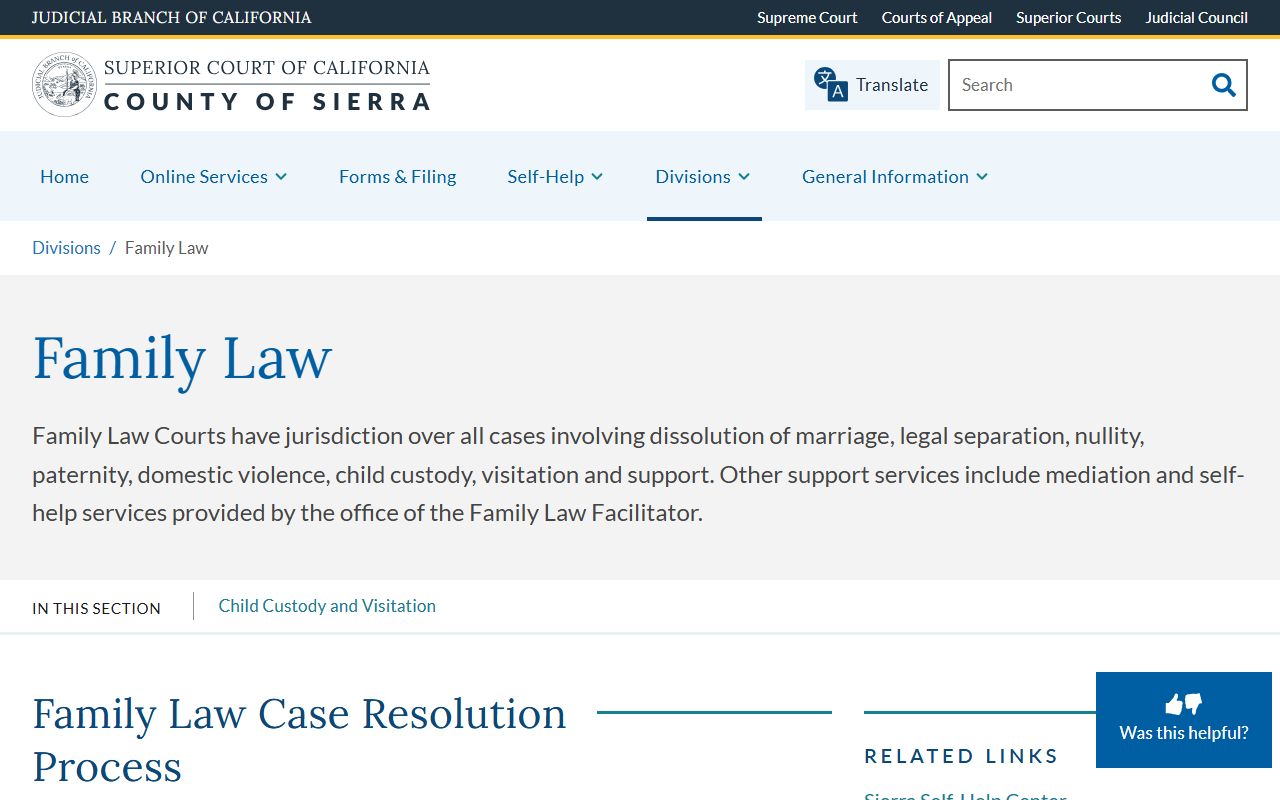
One or two judges handle all case types in Sierra County including family law. Hearings are scheduled on specific days. The clerk can tell you when family law matters are heard. Because the county is small, you may have more direct access to court staff than in larger counties. Staff can answer questions about procedures and forms. Visit the court website at www.sierra.courts.ca.gov/divisions/family-law for general information about family law services.
Downieville is in a remote mountain area. Plan for travel time and weather conditions if visiting in winter. The courthouse does not have security screening like larger courts but you still need to follow courthouse rules. Dress appropriately for court appearances. Turn off cell phones before entering the courtroom. Address judges as "Your Honor" when speaking.
Filing Your Family Law Case
Get the correct forms before filing. California uses standard Judicial Council forms. You can download them from the California Courts website or request copies from the clerk's office. The clerk can tell you which forms apply to your case type. Dissolution cases use form FL-100 to start. Child custody cases use different forms. Complete all forms fully. Incomplete forms get rejected and delay your case.
Bring your completed forms to the clerk's office. The filing fee is $435 for the first paper filed. This covers petitions and responses. Later motions cost $60 each. Some documents have no fee. Ask the clerk when filing if unsure about fees. If you cannot afford the fee, request a fee waiver using form FW-001. The court decides waivers based on income and expenses. Include proof of income with your waiver application.
Service of the other party is required after filing. You cannot serve papers yourself. A person over 18 who is not involved in the case must serve the documents. This can be a friend, relative, process server, or the sheriff. After service, the server fills out a proof of service form. File the proof of service with the court. The case cannot proceed without filed proof of proper service.
Note: In small counties like Sierra, clerk staff may provide more guidance than in large counties, but they still cannot give legal advice.
Getting Help with Forms and Procedures
Sierra County does not have a dedicated self-help center like larger counties. The clerk's office provides basic assistance with forms and procedures. Staff can answer questions about how to complete forms and what documents to file. They cannot tell you what to write in your forms or advise you about legal strategy. That would be legal advice which clerks cannot provide.
Legal Services of Northern California serves Sierra County residents who qualify based on income. They provide free legal help in family law cases. Call (916) 551-2150 or visit their website to apply for services. They handle cases involving domestic violence, child custody, and other urgent family law matters. Wait times exist due to high demand. Income limits determine eligibility.
The California Courts website has a self-help center online at www.courts.ca.gov/selfhelp-domesticviolence.htm and other pages. These resources include form instructions, videos, and guides for various family law topics. Many resources are available in multiple languages. Use these online tools to learn about your case type and required procedures. The statewide family law facilitator program provides help in some counties but Sierra County may not have this service. Check with the clerk's office.
Accessing Court Records
Court records are kept at the clerk's office. You need a case number to request files. Parties to a case can view their own files. Other people may need court permission to see certain documents. Some family law records are confidential by law. The clerk determines access based on the document type and your relationship to the case. Always bring photo ID when requesting records.
Copies cost 50 cents per page. Certified copies add $40 to the copy charge. Certification is required when submitting documents to another court or government agency. Plain copies work for personal use. The clerk makes copies while you wait if the request is small. Larger requests may require you to return later or arrange for mail delivery.
Sierra County does not offer online case search. You must contact the courthouse for case information. Call (530) 289-3698 to ask about case status or get basic information. For detailed information or copies of documents, visit in person during business hours. You can also mail requests. Include your case number, a list of what you need, payment by check or money order, and a stamped return envelope.
Costs and Fees
The initial filing fee is $435. This applies whether you file a petition or response. Motions filed later cost $60 each. Ask the clerk about fees for specific document types if you are not sure. Payment can be made by cash, check, or money order. The court may accept cards but call ahead to verify payment options.
Service costs are separate. Professional process servers charge $75 to $150 typically. The sheriff may charge less. Costs depend on distance and difficulty locating the person. Plan for these expenses when filing a case. Fee waivers cover only court filing fees, not service costs.
Fee waivers are available for people who cannot afford court fees. Form FW-001 is the application. Submit it when you file your first papers. The court reviews income, expenses, and household size to decide if you qualify. A granted waiver covers filing fees and some other court costs. Denied waivers mean you must pay the full amount. You can reapply if your finances change.
Communities in Sierra County
Sierra County has no cities with population over 100,000. All residents file family law cases at the courthouse in Downieville.
Nearby Counties
Jurisdiction is based on residence. Check if you live near a county border.